
I've spent much of the past decade working with local governments to tackle challenges that don't have easy answers. But few issues are as urgent, personal, or consequential to Colorado's future as housing affordability.
We hear it everywhere. Young adults are struggling to purchase their first home. Families are spending an increasing percentage of their income on housing. Teachers, first responders, and essential workers can't afford to live in the communities they serve. Older adults may want to downsize but can't find suitable options.
And perhaps most concerning, Coloradans are wondering whether they can afford to stay in the state they call home.
Housing affordability isn't just a housing issue. It's an economic development issue, a workforce issue, and ultimately, a question about the future of our communities.
We've talked about the problem for years. It's time to accelerate the solutions.
Bringing Practical Solutions to the Table
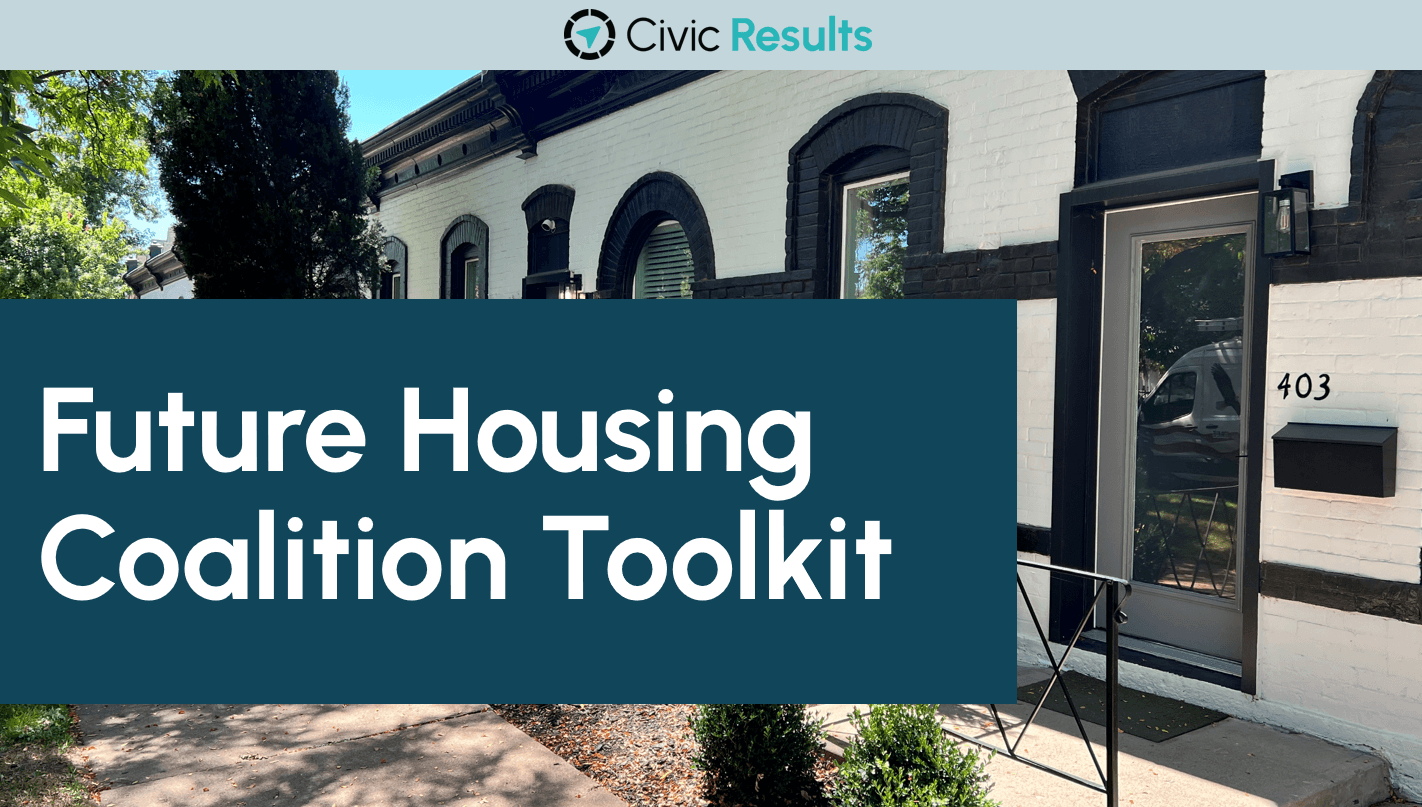
On November 12, Civic Results and our partners will officially roll out the first three phases of the Future Housing Coalition (FHC) Toolkit, an initiative designed to help local governments and housing partners move beyond identifying barriers and begin implementing practical solutions. Register Today!
Our focus is on attainable housing, particularly starter homes and middle housing options for households earning approximately 80% to 140% of area median income (AMI).
The Toolkit includes resources for:
- Communications: To help local leaders engage residents in constructive conversations about housing needs and opportunities.
- Public Sector: Practical zoning and land-use tools that communities can evaluate and adapt to their unique circumstances.
- Private Sector: Strategies for working with local officials to create a more efficient development process.
We're also working on the next critical piece: financing. Because even when communities have the right zoning and development processes in place, the numbers still have to work.
One of the most important lessons we've learned through this work, is that there is no single solution to housing affordability.
Zoning matters. Infrastructure matters. Construction costs matter. Financing matters. Community support matters. We need to address all of them.
Local Solutions, Regional Impact
One of the guiding principles behind the Future Housing Coalition is that local governments need tools, not one-size-fits-all mandates.
What works in an urban community may look very different from what works in a suburban or rural community.
Our Toolkit isn't intended to prescribe legislation or dictate local policy. It's designed to provide options, expertise, and resources that help communities make informed decisions.
And while housing decisions are often made locally, the impacts are regional.
When workers can't afford to live near their jobs, transportation systems feel the pressure. When employers struggle to recruit talent, our economy suffers. When young families leave Colorado in search of affordability, we lose more than residents. We lose part of our future.
That's why collaboration among local governments, developers, lenders, housing organizations, and state partners is so important.
Expanding My Commitment to Housing
I'm also excited to share that I've joined the board of Housing Equity for Colorado.
This opportunity allows me to deepen my involvement in addressing housing challenges across our state and contribute to efforts that are focused on creating more equitable and attainable housing opportunities.
Between my work at Civic Results, through the Metro Mayors Caucus, the Future Housing Coalition, the Municipal Leadership Academy and now Housing Equity for Colorado, I see tremendous opportunities to connect conversations, build partnerships, and advance practical solutions.
I don't believe any one organization or sector can solve this challenge alone. But I absolutely believe we can make meaningful progress when we work together.
The Time for Action Is Now
I often think about what Colorado will look like for the next generation.
Will our children and grandchildren be able to purchase homes here? Will the people who teach our children, protect our neighborhoods, and keep our local economies running be able to afford to live in our communities?
These are questions that deserve more than another study or another conversation about how difficult the problem has become.
They deserve action.
We hope to see you on November 12 for our second session in our six-part housing series. We don't need to agree on every housing policy to agree that Colorado needs more attainable homes.
We need creativity, collaboration, a willingness to try new approaches, and a commitment to results.
Because the future of Colorado depends on the decisions, we are willing to make today.


